


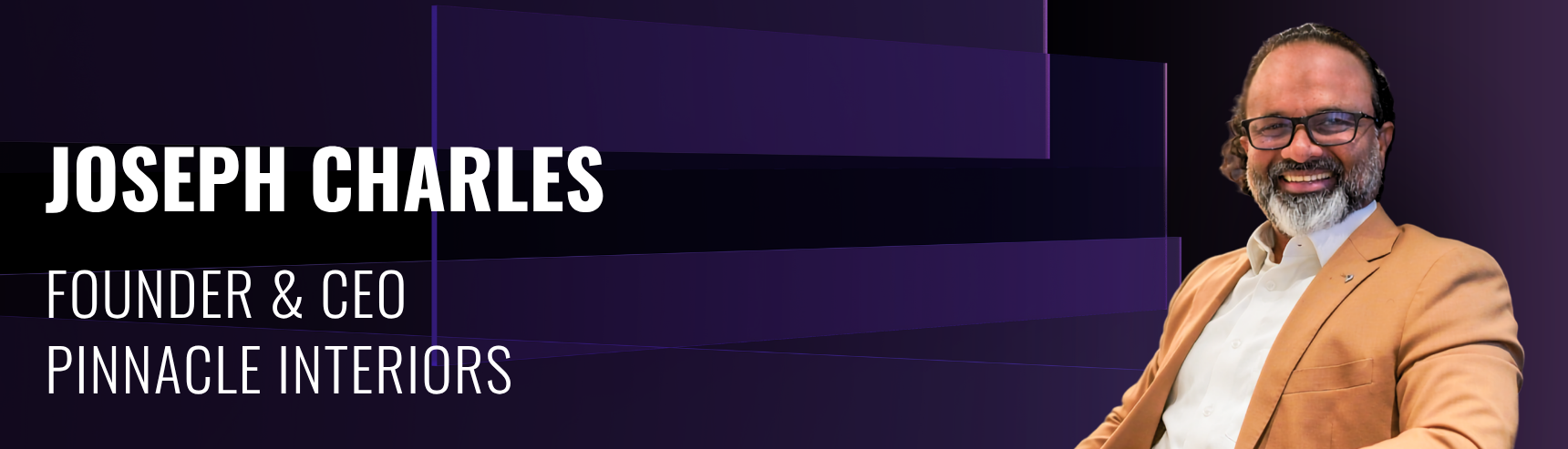
1. After delivering projects across workplace, healthcare, hospitality and retail, what does a successful space look like six months after handover?
People think handover is the finish line. It isn’t. To me, that’s just when the space starts proving whether we got it right.
Six months later, I don’t judge a project by the marble, the joinery or the lighting alone. I look at the people. Are they using the space naturally? Has it become part of their routine? Is the workplace driving better collaboration? Is the clinic helping people feel calmer the moment they walk in? Is the restaurant alive on a Tuesday night because the atmosphere works? That’s the real test.
A successful space feels occupied, accepted and loved. It supports the business, it supports the people, and it keeps delivering long after the ribbon is cut. That’s what matters to me.
I’ve always believed we’re not in the business of building interiors. We’re in the business of creating environments where people succeed. When a client tells me, “Charles, this space has changed the way we work,” or “Our customers love being here,” that’s worth more than any trophy sitting on a shelf.
2. In fit-out, the gap between a design concept and the final built space is where many challenges emerge. How do you protect the original vision through execution?
This is where projects are either won or lost.
Anyone can produce beautiful renders. The real challenge is standing in the finished space months later and seeing exactly what was imagined on day one.
That takes obsession.
Every detail matters. Every material matters. Every shadow line, every corner, every millimeter matters. I still walk sites today because I genuinely believe details define excellence.
Challenges will always be there— delays, variations, site conditions, and budget pressure. But none of that should be an excuse to dilute the design. The question is never, “What is easiest?” The question is, “How do we solve this without losing the soul of the project?” That’s the job.
3. Looking back on your career, what project taught you the most about the realities of delivering great design?
If I’m honest, every project has taught me something.
After more than thirty years, I still learn from every single job.
The biggest lesson I’ve learned is that beautiful design means nothing without brilliant execution.
Early in my career, I realized that clients don’t remember how impressive your presentation was. They remember whether you delivered what you promised. They remember how you responded when problems appeared. They remember whether you cared as much at practical completion as you did during the pitch.
That changed my entire outlook.
Today, I tell every member of our team that our reputation is built long before the client notices it. It’s built in the conversations we have, the decisions we make when nobody is watching, and the pride we take in getting the smallest details right.
Excellence isn’t luck. It’s discipline, repeated every single day.
4. What’s the first thing that breaks when a fit-out firm scales too fast – and how do you stop it?
Culture.
Not systems. Not software. Not processes.
Culture.
When companies grow too quickly, people become numbers, communication suffers, and standards begin to drift. That’s when quality slips.
I’ve never wanted Pinnacle Interiors to become the biggest company in the market.
I’ve always wanted us to be one of the best.
I’d rather deliver one exceptional project that clients remember for years than ten average ones that nobody talks about.
That’s why we invest so heavily in our people. Buildings don’t build themselves. Great people build great projects!
5. Many companies can deliver a project. Fewer build long-term client relationships. What have you learned about earning trust in this industry?
Trust is earned long after the contract is signed.
It’s earned when things don’t go according to plan, and the client knows you’ll find a solution.
It’s earned when you answer the phone.
It’s earned when you take ownership instead of making excuses.
Some of our clients, such as Prime Health, have trusted us with dozens of projects over many years. That’s something I’m incredibly proud of because it tells me they value more than our ability to build. They value our integrity.
I’ve always believed every project should be treated like the first project you’ve ever done for that client because it could determine whether they ever call you again.
The greatest achievement in my career isn’t the awards we’ve won. It’s a client saying, “We’ve got another project, and we want Pinnacle to do it.” Nothing means more than that.
6. What’s changed most about how this city builds interiors over the past 30 years?
The UAE and, particularly, Dubai have never stood still, and neither has our industry.
I’ve had the privilege of watching this city transform from an ambitious regional market into one of the world’s most exciting places for design and construction.
Clients today expect so much more than beautiful interiors. They want workplaces that inspire innovation, healthcare facilities that improve patient wellbeing, hospitality venues that create unforgettable experiences, and sustainable spaces that stand the test of time.
The bar keeps getting higher.
That’s what I love about Dubai.
This city challenges you every day to think bigger, build smarter, and innovate faster.
If you stand still here, you get left behind.
For me, that’s what has made the last thirty years so rewarding. Every project has pushed us to become better than the last.
7. If a client could invest in only one aspect of a project, where would you tell them to spend the money?
Without hesitation, invest in great design.
Not because I’m passionate about design, but because I’ve seen what happens when clients don’t.
Great design solves problems before they exist. It improves productivity. It strengthens brands. It enhances well-being. It reduces costly mistakes during construction and creates value that lasts for years.
People often think the expensive part of a project is the finishes.
It isn’t.
The most expensive thing is getting the fundamentals wrong.
When the planning is right, everything else falls into place.
That’s why I’ve spent my career championing design-and-build. When designers, engineers and construction teams work together from day one, incredible things happen.
The best projects aren’t the ones with the biggest budgets.
They’re the ones where every decision has purpose, every detail has meaning, and every space makes people’s lives better.
That’s why I still love what I do after more than thirty years!
Read it. Loved it. Now what?
More ideas, naturally. Explore more insights from WORKSPACE, or discover the latest thinking shaping hospitality and interior design from The Hotel Show and INDEX. Better yet, experience all three industries under one roof at Dubai World Trade Centre, 1–3 June 2027. One registration. Three shows. Zero difficult decisions.